
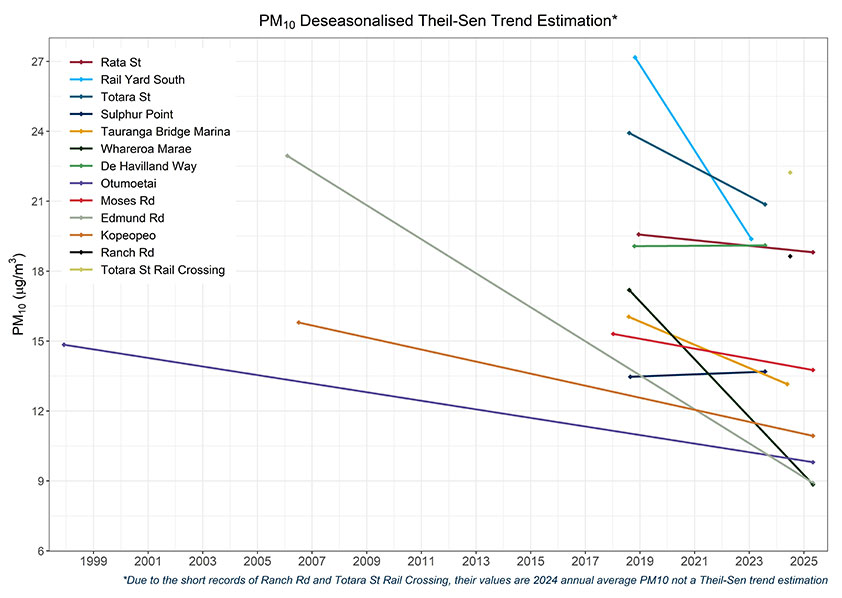
Figure above - The LAWA recommended trend analysis technique. It should be noted that some sites still have relatively short periods of record. Downward sloping lines indicate an improvement in particle driven air quality.


We are committed to ensuring everyone in Mount Maunganui has clean, safe air to breathe.
By working with other agencies, responding to community concerns, and closely monitoring industrial activity, we’re seeing measurable improvements. Improving air quality is a shared responsibility, and we all have a role to play.
We’ve been monitoring air quality in the Mount Maunganui industrial area since the 1990s. In 2018, we expanded this monitoring to include a network of highly accurate reference-grade monitors, where pollution is most concentrated. This helps us identify issues, understand long-term trends and ensure compliance with national standards and regional rules.
Early monitoring showed elevated levels of dust particles called ‘particulate matter’, with readings regularly exceeding the health protection limits set in the National Environmental Standards for Air Quality. This led to an air quality management zone (or Airshed) being established over the industrial area, and this area soon after classified as ‘polluted’ due to the number of exceedances. This status change triggered stricter rules and led to tighter resource consent limits and controls on discharges to air.
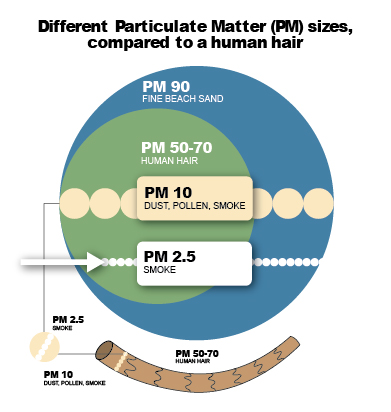
PM10 exceedances may be excluded from official air quality records if they are confirmed as “exceptional events” by the Minister for the Environment. These are unusual natural or human-caused events that are beyond the Regional Council’s control, difficult to predict, unlikely to occur often, and consistent with the purpose of the Resource Management Act. Regional Council has previously sought exemptions for events such as sea spray, bushfire smoke, and airport resurfacing dust. When an exceedance is recorded, staff investigate the likely cause and, if the criteria are met, can apply for it to be excluded.
We monitor air pollution against the limits set out in the National Environmental Standards for Air Quality and Ambient Air Quality Guidelines. The World Health Organization global air quality guidelines are not standards or legally binding criteria in New Zealand, but they too offer evidence-informed recommendations on air quality levels that pose important risks to public health.
This monitoring focuses on pollutants with known health impacts, including:
We also have 11 air quality ‘indicators’ in nearby residential areas to track PM10, PM2.5, and NO₂ in real time.
Note: this network is currently being reviewed to determine if it is fit for purpose and providing value.

In 2020, Regional Council updated the air quality rules in the Air Chapter of the Regional Natural Resources Plan through Plan Change 13. This Plan aims to protect and improve air quality by setting rules for those who want to discharge contaminants into the air.
Plan Change 13 was focused on better addressing issues with fine dust, namely from the handling of logs and bulk solid materials such as palm kernel. Some of the proposed rules were appealed and then debated through the Environment Court over several years, with the final decision delivered in April 2025.
The decision included:
It also required Regional Council to develop an iterative management policy for air quality in the Mount Maunganui Airshed (Policy 12) and develop a Mount Maunganui Airshed Regulatory Implementation Action Plan with other agencies and stakeholders.
The Government has since placed a moratorium on all plan changes until 2027. Once this has lifted, we will assess whether further rules are needed and if so, look to progress these through Plan Change 18.
Since expanding our monitoring network in 2019, we've seen a general downward trend in PM10 exceedances, showing a reduction in the amount of dust detected.
Figure above - The LAWA recommended trend analysis technique. It should be noted that some sites still have relatively short periods of record. Downward sloping lines indicate an improvement in particle driven air quality.
Our monitoring shows the dust in the area comes from both natural and man-made sources:
Through the Regional Natural Resources Plan and the resource consent process we can put controls in place around some of these activities but many, like vehicle or shipping emissions, and some Port-based activities like the movement and loading of logs, we cannot.
Odour remains a significant issue for some people living close to the industrial area, with common complaints linked to bitumen, hydrogen sulphide (“rotten egg smell”) and other industrial processes.
While businesses on industrial-zoned land are permitted to produce some odour, Ministry for the Environment guidelines are clear: there should be no offensive or objectionable odour beyond a property boundary. Verifying a breach of these rules can be difficult as real-time monitoring technology is limited, so we rely on trained staff to investigate reports.
In 2024, we mapped potential odour sources across the industrial area to identify where and when odours were strongest. This has led to closer collaboration with industries to address recurring problems—checking that treatment systems and chimneys and vents are operating correctly, materials are managed properly, and consent conditions (including the use of scrubbers, filters, or activated carbon) are met.
Exposure to odours can have a wide range of health effects—from none, to mild discomfort, through to more serious symptoms over time. In June 2023, Toi Te Ora Public Health commissioned the Institute of Environmental Science and Research Limited (ESR) to produce a report titled Air Pollution: Health Risk Assessment Mount Maunganui. You can view this report here.
If you notice a strong or offensive odour, call the Pollution Hotline on 0800 884 880. Our officers can’t be everywhere at once, so your calls are vital in identifying compliance issues like strong odours or thick smoke. These reports also help shape policy, resource consent decisions, and enforcement actions.
The Air Chapter of the Regional Natural Resources Plan sets rules about what can be discharged to air and what activities require resource consent. It’s important that everyone who needs a consent has one, and that is why we audit businesses operating in industrial areas to check they are aware of and are meeting the rules.
Resource consents are one of Regional Council’s main tools for managing air quality. There are approximately 29 air discharge consents in the Mount Maunganui industrial area and these are monitored regularly, depending on the conditions, risk and compliance history.
A common debate in this process is around consent terms. While some would like to see shorter consents (for example, five years) with international best practice applied straight away, businesses often point out that installing new state of the art equipment is a significant investment. They need longer consent terms to justify and recover those costs.
This Guide to applying for resource consent for a PM10 discharge provides direction for the Mount Maunganui Airshed. It supports applicants and consent planners to consistently prepare and evaluate applications within the wider context of managing an already polluted airshed and meeting the ambient PM10 standard under the National Environmental Standards for Air Quality.
The guide aims to promote fairness and equity for all applicants, while supporting a consistent and transparent consenting approach.
A supporting table of PM10 percentile concentrations is provided and will be updated periodically to reflect the most recent monitoring data.
Whareroa Marae is home to Ngāi Tūkairangi and Ngāti Kuku hapū and sits next to the industrial zone. Its proximity to pollution sources raises important cultural and health concerns.
We installed a dedicated air monitor at the marae in 2015 to track PM10, SO₂, and H₂S. The last SO₂ exceedance was in 2016 and the last PM10 exceedance in 2018.
In response to community concerns, we and Tauranga City Council co-funded an independent investigation into the feasibility of relocating nearby industry. The findings have been handed to the marae for consideration.
Your reports help.
Please call our 24/7 Pollution Hotline on 0800 884 883 if you smell strong odours or notice smoke, dust, or spray drift.
Methyl bromide is a toxic, ozone-depleting gas used primarily to fumigate exported logs. in order to meet biosecurity requirements of the country receiving the shipment, principally China and India. It is also used to treat some imported products to ensure that no pests or diseases are brought into New Zealand.
In 2021, the Environmental Protection Authority introduced new rules for using methyl bromide to fumigate products and packaging. Find out the rules and learn more about an alternative fumigant called Ethanedinitrile.
If you experience strong odours, black smoke, dust clouds or spray drift, call our Pollution Hotline immediately on 0800 884 883.
Mount Industrial Community Newsletter