


From Te Urewera to Netflix and the big screen
Biosecurity officer by day, film star by night. How a quiet kid from Ruatāhuna found himself in the movies.
“Tūwhiti te hopo. Just do it,” says Te Wakaunua Te Kurapa. “Or feel the fear and do it anyway.” He is talking about his first experience of acting, in a film that has gone on to screen on Netflix – much to the surprise and delight of his family and friends.
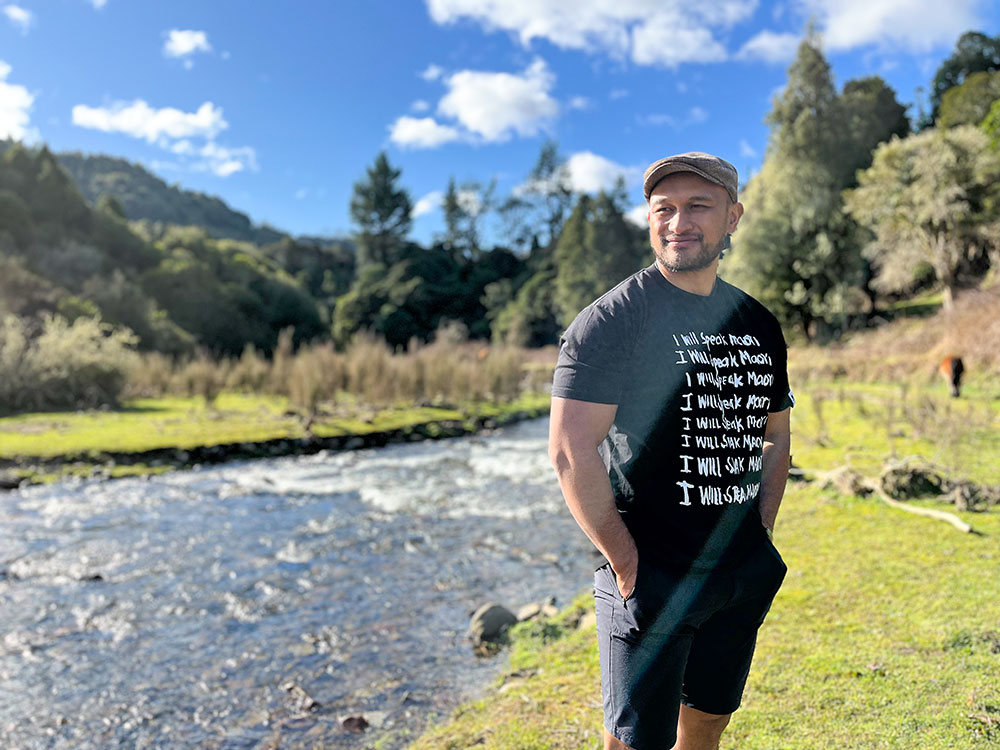
Te Wakaunua, who more often goes by the name Waka, is a self-confessed introvert. His day job is as a biosecurity officer at Bay of Plenty Regional Council. Acting is quite a departure, yet he has now played the same role in two different films: We Are Still Here, which is currently screening on Netflix, and most recently, Ka Whawhai Tonu, Mike Jonathon’s historical action drama starring Cliff Curtis and Temuera Morrison.
Although the two films are unrelated, both feature Waka’s direct ancestor Te Whenuanui, who he plays in both films. Te Whenuanui was a renowned Tūhoe rangatira who in 1864 had to decide whether to support neighbouring tribes in their fight against colonial forces.
“They aged me up a lot for the first film,” Waka says. “The beard was a prosthetic.” He grew his own beard for Ka Whawhai Tonu.
Te Wakaunua found himself in the role after kuia from his marae recommended him to the We Are Still Here film makers. Stepping onto the set for the first time, he was way out of his comfort zone.
“I had no understanding of how a set worked,” he says. “They told me there was a rawness about me that they didn’t want to take away by giving me acting training. So that first day on set, I was terrified. When they called the first ‘Action!’ I froze. I knew all the lines back to front, but I froze.”
He says he settled into it after a few takes. Despite the nerve-racking start, the cast and crew were supportive and it never felt like he wasn’t supposed to be there.
“Leading up to filming, my elders had assured me that no one else could play this role but me,” says Waka.
“They told me, ‘Kei roto i a koe te ira o tō tūpuna,’ meaning in a sense that I AM Te Whenuanui.
That’s what carried me through: The sense of duty to tell the story of my tupuna, and being selected by my elders to represent him.”
Waka was raised speaking Māori as his first language. He grew up in Ruatāhuna in Te Urewera, also the home of Te Whenuanui, who built the wharenui at Mataatua marae.
“I was privileged to have that upbringing,” he says. “We essentially lived off the land. We hunted for our meat and grew our own vegetables. Te Urewera has nurtured my people for hundreds of years and it has nurtured me.”
He describes Te Urewera as a kind of therapy, a place to reset himself. “From my Māori point of view, Te Urewera is a place of healing, of whakapapa. It’s a taonga. But what’s noticeable when I go into the bush with my dad is how our natural environments are deteriorating, including in Te Urewera, in areas where pests are going unchecked.”
It’s a concern that informs his professional appraisal of the Rotorua lakes, the area he is responsible for in his biosecurity role at the regional council. Catfish and invasive weeds are the most high-profile pests, with lakeweed the most visible. But people are becoming more aware of the importance of pest management, Waka says. He works closely with Te Arawa Lakes Trust, an iwi agency that does most of the pest management work in the lakes area.
When speaking with Waka, it becomes apparent that there is a direct line between his deep connection to his Māori heritage and his passion for working with iwi organisations on environmental protection. “Being in nature, and in Te Urewera in particular, gives me a sense of being close to my tūpuna. I’m literally walking the tracks that they used to walk. The names of places – streams, rivers, ridges – they all tell stories about my people’s history.
“I don’t have such a strong whakapapa connection to the lakes personally, but there will be those in Te Arawa Lakes Trust who do. For them it’s not just a 9-5 job,” he says.
“They have skin in the game. I love collaborating with Māori and empowering them.”
He says there is a lot for biosecurity to gain from mātauranga Māori. Uwhi mats are a prime example. The native flax mats are secured to the lakebeds to suppress the growth of invasive weeds, allowing native kōura (freshwater crayfish) to repopulate. As the flax breaks down it provides nutrients for native plants that can then grow through the weave of the mats. Uwhi mats have been successfully trialled by Te Arawa Lakes Trust since 2021.
“People relate to the lakes differently,” says Waka. “For Te Arawa, it’s more than just a place you go to launch your boat or an amenity to increase the value of your house. They view the wider picture as opposed to just the job in front of them. That’s reflected in the effort that they give when they’re doing the work.
“It’s a natural fit for the people who have occupied this land for centuries to be empowered to protect that land. It’s a very satisfying part of my job, seeing more Te Arawa people being paid to look after their taonga.”
As for the acting, there is potentially more work if he wants it. He has an agent, recommended to him by Cliff Curtis (which is not something most council staff get to say). But Waka will only accept another acting role if it’s the right fit. “It will be a journey all over again to play a different character because I have an emotional connection to my tupuna.”
“And I love my job,” he adds. “Looking after the environment, that’s what gives me energy.”