


Working with nature, not against it
Climate change means coastal flooding will likely get worse. Meet a coastal engineer who says that’s nothing to be afraid of, so long as we understand our options.
Ana Serrano loves the ocean. “Lakes are boring,” she says cheekily. “The ocean is all waves, currents, storm surges. Everything is moving left and right.” Her eyes light up, as they often do when she’s talking about her job. “I love it.”
From splashing as a baby in the Mediterranean Sea to snorkeling as an adult in the Bay of Plenty, the ocean has been a constant in Ana’s life – and her career. She holds a Masters in Coastal and Marine Engineering and Management, and describes herself as a ‘nature-friendly engineer’.
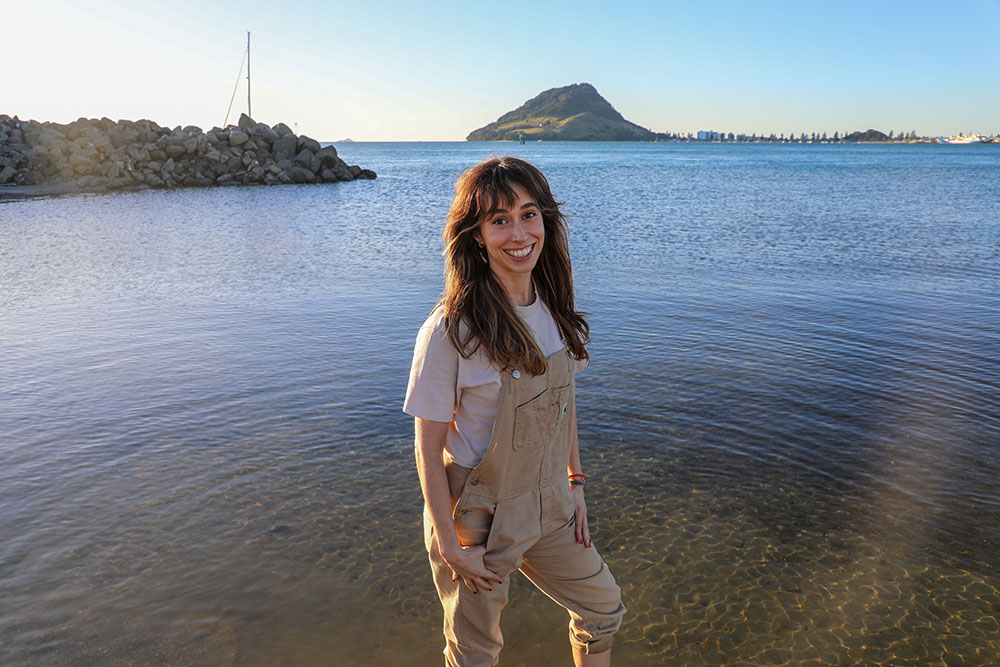
To speak with Ana about her work is to enter a world where the ocean acts as a restless sculptor, constantly shifting sand and shaping coastlines. It’s a force that Ana says we need to work with, rather than against. Suddenly a simple seawall seems inadequate, even short-sighted.
Ana is a senior advisor in climate resilience, working in the Climate Change team at Bay of Plenty Regional Council. She is particularly interested in helping communities respond to the effects of our changing climate as it manifests in low lying areas.
“Even in the last 10 to 20 years, people have thought they were fine to farm or live in low lying areas, but now they’re starting to suffer the impacts,” she says. Some of those impacts include erosion and coastal inundation, saltwater intrusion into crop lands, and more frequent flooding.
“At Waihi Beach, for example, you might have a flood event that happens two or three times a year, but some models predict that just 10cm of sea level rise could turn that same level of event into something that starts happening five or six times a year.”
Her nature-friendly approach to engineering was seeded at a young age when she encountered what she calls ‘bad tourism’.
“Growing up in Barcelona, my family used to holiday at Costa Daurada, the Golden Coast,” she says, recalling the half-hour walk that her family would take to get to the beach. “Each of us would carry something: food, the parasol, sun chairs, towels, snorkel equipment. Our path was mostly past quaint houses, pine trees, and through wetlands.”
But over the years, development swallowed the landscape. “The charming houses and farms were gradually replaced by towering hotels and buildings. Nature seemed to recede. The place I grew up loving no longer felt the same. Instead, it was cheap tourism: Buildings and rubbish and litter. I didn’t understand how anyone could let that happen. It broke my heart to see the natural environment being so disrespected. It really lit a fire in me.”
Such a fire, in fact, that she took part in protests to protect the wetlands. “But our efforts seemed mostly in vain.”
A high achiever at school, she turned her focus toward understanding more about the delicate relationship between progress and preservation. Ana was the first generation in her family to go to university. With her deep love for the ocean, she chose coastal engineering, the engineering part coming easy for her. “I have always been very good with numbers, and at the end of the day, numbers are the same in every country.
She studied for her Masters at three different universities in England, Norway and the Netherlands, thanks to a scholarship. She says it gave her the chance to see the different ways that each country approaches coastal issues and storm surges.
“We can learn a lot from other countries. New Zealand is building its own memory of climate impacts, but people still forget. When there hasn’t been a bad storm in a while, we get a false sense of security.”
Ana says there are lots of places at risk in the Bay of Plenty. “Some people inevitably will need to relocate, even whole communities, that’s just a fact,” she says bluntly. She adds, “But it’s not the council’s job to tell the community what to do. If there is a strong attachment to a space, people might be more likely to accommodate the coastal risk. Every community has different thresholds for how much disruption they are willing to put up with.”
She says one of the most important questions for every community is “what matters most?”.
“It’s the community’s values that should guide the way forward. If you value your beach, you won’t just build a seawall because in ten or fifteen years you won’t have a beach there anymore. So, what is it that the community really values? We need to understand these values to find the right solutions.”
In 2023, Ana was part of a team offering technical advice and support to the Waihi Beach Lifeguard Service as they grappled with how to deal with coastal inundation. On top of a severe flood, Earth Sciences New Zealand (formerly GNS) had identified the club as one of the most at risk in the country for ongoing inundation.
Conversations with the regional council’s Climate Change team led to a funding application for climate adaptation planning. Ana says, “We were able to take them through a collaborative process so that by the end of it, they owned the solution. Not just as club volunteers, but as a community.”
The resulting adaptation plan charts a way forward for the lifeguard club, but it’s not a linear set of actions. Instead, the plan branches out like a choose-your-own adventure map that offers several possible pathways for the club to take, depending on how the future unfolds. One pathway points towards a potential redesign of the building’s ground floor, other pathways lead to using a new hub at a different and safer location. As conditions evolve over time and some options become outdated, the club will switch to alternative pathways.
Ana says the important thing is that, after initially receiving a “scary report from GNS”, the club now has a clear idea about their options going forward, and they have identified the various triggers that will require them to take each particular pathway.
“Knowledge is power,” she says. “That’s my favourite part of working with communities. There is lots of risk along the coast, but we don’t need to be afraid of it. We just need to know the options. It’s my job to help people understand what those options are.”