


Containment for conservation: stopping the spread of wallabies
If you look left driving south out of Rotorua on State Highway 5, you may notice a fence on the edge of the Whakarewarewa Forest. While it may look like a typical wire fence, it has an important role to play in the pest management of wallabies – a significant problem to the local environment and economy.
The fence was designed and built as part of Tipu Mātoro, the National Wallaby Eradication Programme. Established in 2020, this partnership programme has a long-term aspirational goal of a wallaby-free Aotearoa.
To achieve this, the programme strategy is to prevent wallabies from spreading outside of areas where they are already established, called the containment area, then systematically working inwards to eradicate them.

Davor Bejakovich, Tipu Mātoro Central North Island Wallaby Programme Lead, says this fence helps protect native forests, commercial forestry and farmland from the impacts of wallaby browsing.
“The fence runs for 12.5km from Rotorua to Lake Rotokakahi and is designed to stop wallabies from crossing the highway and spreading south, where other wallaby control methods are successfully reducing numbers.”
Wallabies were first released near the Rotorua Lakes area in 1912. Since then, they have spread across more than 200,000ha of the Bay of Plenty and Waikato regions.
“It’s estimated that, if left unchecked, one third of the North Island could be impacted by the spread of wallabies by 2065,” says Mr Bejakovich. “That has huge financial, social and cultural impacts for everyone.”
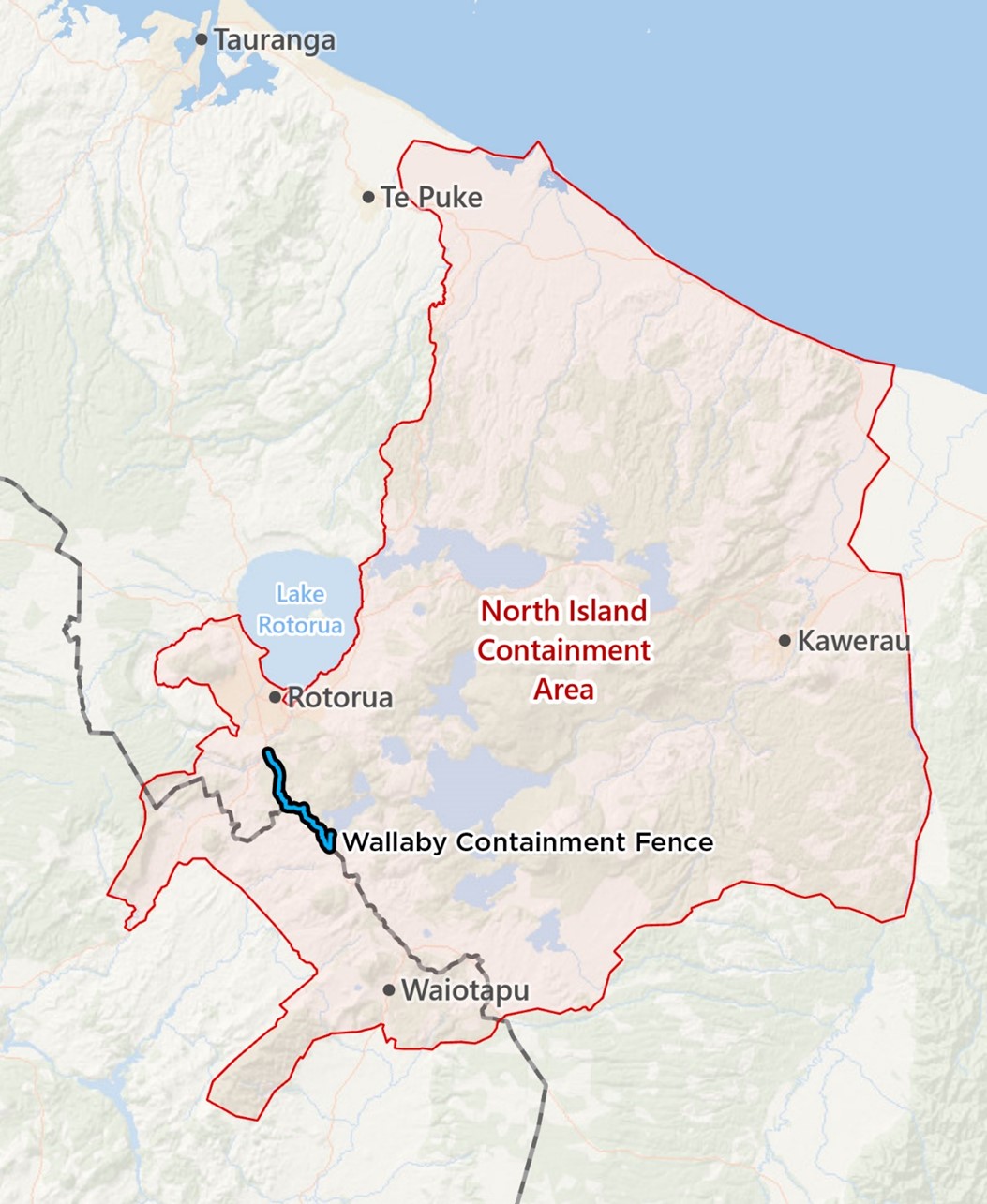
Wallaby containment fence location within the North Island Containment Area.
The North Island containment area is approximately 260,000 hectares and uses natural wallaby barriers (such as rivers, steep gorges and lakes) to help shape its boundaries.
Whakarewarewa Forest is 5,600ha of privately owned land containing commercial forestry interspersed with popular, publicly accessible walking, running and mountain bike trails. Given the public accessibility, undertaking wallaby control work – which typically involves night shooting or pesticides – is difficult and, therefore, the use of the fence is a more effective option for preventing their spread.
Unlike their kangaroo cousins, wallabies don’t typically jump over fences; instead, they prefer to push through or under.
The containment fence along the edge of Whakarewarewa Forest is similar in height to a standard farm fence, but it differs by having smaller gaps in the netting and an additional 30cm ‘skirt’ at the bottom which lies flat on the ground to stop wallabies from burrowing underneath.
Trail cameras that have been strategically placed along the fence line reveal that when wallabies encounter the fence, they will typically travel a short distance along it before turning away and heading back into the forest.
At the southern end of the fence, Lake Rotokakahi acts as a natural boundary to prevent further wallaby spread, while at the northern end the fence starts slightly south of urban Rotorua.
The containment fence offers a short-term solution to help stop the spread of wallabies, while Tipu Mātoro conducts research to improve wallaby detection and control methods for the eventual elimination of wallaby from the region.
Construction of the fence was funded by Tipu Mātoro, and ongoing maintenance costs are the responsibility of Toi Moana Bay of Plenty Regional Council.
Tipu Mātoro is a national eradication programme and a partnership of Biosecurity New Zealand (BNZ), iwi and regional councils in wallaby-affected areas, the Department of Conservation (DOC), Federated Farmers, Forest & Bird, Land Information New Zealand (LINZ), farmers, foresters, landowners, researchers and communities.