Skip to main content Skip to footer
Menu

Simplifying Local Government

What should local government look like for our region? 

The Government has announced a new voluntary Head Start pathway for councils that want to put forward local government reorganisation proposals ahead of wider reform from 2028.

We are seeking community feedback as part of that conversation. Public input will help identify the values, priorities and outcomes that matter most, so any future model can be assessed against what will best serve the Bay of Plenty – now and into the future.

Our survey will open on Monday 29 June and be available on this page.

The Government has announced a new voluntary Head Start pathway for councils that want to put forward local government reorganisation proposals, ahead of wider reform from 2028.

Under this pathway, city and district councils can work together to outline proposals for new unitary authorities for their areas (unitary authorities are councils that combine both local and regional functions into one organisation). 

These proposals are due to the Government by 9 August 2026, with decisions on which proposals progress expected in September 2026, and final decisions on detailed proposals due in 2027.

The Government says these changes are intended to make local government simpler, more efficient and more affordable, while also supporting the transition to a new planning system.

For regions that do not move ahead through Head Start, wider reform is expected after the 2028 local elections through a separate ‘backstop’ process.

Further reading

Department of Internal Affairs

Beehive

Key dates

Head Start proposals open May 2026

Outline proposals submitted to Government August 2026

Cabinet agrees proposals in principle September 2026

Final proposals submitted March 2027

Cabinet confirms proposals May 2027

Cabinet makes final policy decisions May 2027

Cabinet approves legislation Q3/Q4 2027

Legislation introduced Q3/Q4 2027

Legislation enacted Q1 2028

Proposal implementation begins May 2028

Nominations for local elections

Backstop begins October 2028

Local elections October 2028

What’s happening now?

Councils around New Zealand are currently considering, or have decided, to take part in the Head Start pathway and some are seeking feedback from their communities before key deadlines.

In the Bay of Plenty, discussions are underway about what local government could look like in the future and what matters most to our communities. These are early conversations and no final decisions have been made.

Find out more from your local council


Our approach

We agree there is room for improvement in how local government works, and are open to change where it leads to better outcomes, affordability and service delivery for our communities. Any future model must leave the Bay of Plenty the same or better than it is today, and do so fairly for communities across the whole region.

Under the Government’s Head Start pathway, regional councils cannot submit outline proposals and are not the decision makers on whether a proposal goes forward.

Our role is to contribute evidence, explain how regional services work, support informed discussion, and work alongside city and district councils as the region considers its options.

Speak to your Regional Councillors 
about this work

Chair Matemoana McDonald Mauao Māori 
matemoana.mcdonald@boprc.govt.nz 

Mawera Karetai Kōhi Māori 
Mawera.Karetai@boprc.govt.nz 

Iwi te Whau Ōkurei Māori 
Iwi.TeWhau@boprc.govt.nz  

Stuart Crosby Tauranga
Stuart.Crosby@boprc.govt.nz 

Deputy Chair Glenn Dougal Tauranga
Glenn.Dougal@boprc.govt.nz  

Kate Graeme Tauranga
Kate.Graeme@boprc.govt.nz 

Kat Macmillan Tauranga
Kat.Macmillan@boprc.govt.nz 

Tim Maltby Tauranga
Tim.Maltby@boprc.govt.nz 

Sarah McCorkindale Eastern Bay of Plenty
Sarah.McCorkindale@boprc.govt.nz 

Anna Grayling Rotorua
Anna.Grayling@boprc.govt.nz 

Raj Kumar Rotorua
Raj.Kumar@boprc.govt.nz 

John Scrimgeour Western Bay of Plenty
John.Scrimgeour@boprc.govt.nz 

Ken Shirley Western Bay of Plenty
Ken.Shirley@boprc.govt.nz 

What do you think?

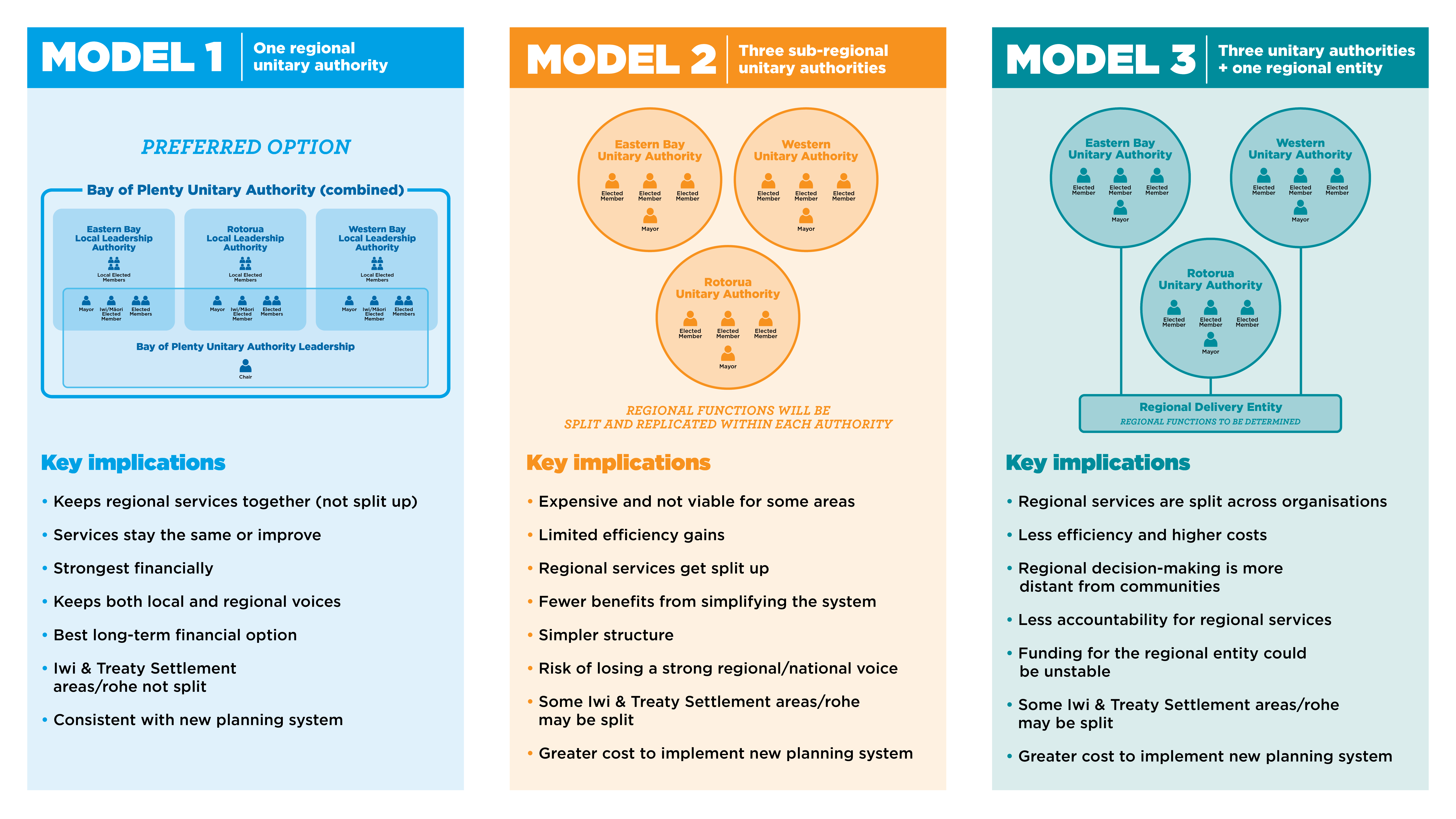
Our survey will include questions asking for feedback on the three models below. We know these each have distinct strengths and trade-offs. 

The full survey will be available from Monday 29 June.

Simplifying local government models

What matters to you? Let us know

Between Monday 29 June and Sunday 12 July we will be seeking community feedback as part of that conversation. Public input will help identify the values, priorities and outcomes that matter most, so any future model can be assessed against what will best serve the Bay of Plenty – now and into the future.

Related documents:

You will be able to find the survey here, once it opens.

Community events

Come and talk to regional council representatives about this work.

Saturday 4 July 2026 7am to 12pm - Kuirau Park Markets
Stop by on your way to check out the great kai available for breakfast at these markets.

Saturday 4 July 2026 8am to 12pm - Fergusson Park, Tauranga
Pop by the Toi Moana gazebo next to the BBQ at Ōtūmoetai Football Club on Tilby Drive to fill in a survey and chat with our friendly staff.

Saturday 4 July 2026 8am to 12.30pm - Ōhope Markets
See you at the monthly markets at Ōhope Hall on Bluett Ave.

Contact us

Have questions or want to learn more about this work?

Phone us 0800 884 880
Email simplifyinglocalgovernment@boprc.govt.nz
In writing Simplifying Local Government Project Team
Attention: Governance Manager
Freepost 122076
Bay of Plenty Regional Council
PO Box 364
Whakatāne 3158


What happens next?

Over the coming weeks, councils that are considering the Head Start pathway will continue their conversations with communities and stakeholders ahead of the 9 August 2026 deadline for outline proposals.

Our focus remains on working constructively alongside other councils in the Bay of Plenty, sharing evidence on regional service delivery, and helping ensure that any future changes are practical, fair and built to last.

The work we do

Some council functions do not stop at city or district boundaries. Rivers, catchments, flood risks, pests, public transport networks and environmental pressures all operate across the wider region. That is why some services are best planned and delivered at a regional scale.

Regional-scale delivery helps support clearer coordination, consistent standards, long-term planning and better resilience in emergencies. It also helps reduce duplication and makes it easier to align planning, funding and delivery across the Bay of Plenty.

Examples of regional work include:

  • Flood protection and river management, because what happens upstream can directly affect people, property and infrastructure downstream.
  • Biosecurity, because pests and diseases do not stop at council boundaries and require coordinated action, specialist expertise and reliable long-term funding.
  • Regional planning, environmental monitoring and water management, because these systems depend on joined-up decision-making across the wider region.
  • Public transport and other region-wide networks, because consistent planning and investment across council boundaries supports better outcomes for communities and businesses.

Whatever local government looks like in future, it will be important to retain the benefits of well-coordinated regional delivery, while making sure communities continue to have a meaningful local voice.

Our functions - a quick summary

Healthy Catchments

Biosecurity and pest management, freshwater and catchment restoration, Rotorua Te Arawa Lakes (Crown-funded), climate adaptation, regional parks

112 specific regional pest management plans, 280,000 visits to regional parks, 300+ Priority Biodiversity areas

Annual cost around $43.6m ($33.4m OPEX; $10.2m CAPEX)

Funded: 90% funded through regional rate or investment income

Example in action: Kaituna catchment in partnership with iwi and govt, converted 90 hectares (70 rugby fields) to wetland, and planted 700,000 native plants. 

Regulatory Services

Resource consents (air, water, hazards), compliance, monitoring and enforcement, maritime/Harbour Master, Civil Defence (CDEM)

Assess 700 consent applications, 4,000 compliance monitoring inspections, more than 2,000 pollution hotline calls, maintain 850 navigational aids

Annual cost around $26.3m OPEX

Funded: 20% targeted rate, 50% regional rate or investment income, 30% fees and charges

Example in action: Regulatory and science support to Rotorua Air Quality – ultimately resulted in reduction of years of life lost (596 to 246). 

Transportation

Public transport (Baybus), network and service planning, Regional Land Transport Plan

2.38m trips per year – that’s equivalent to the entire population of Tauranga being moved every two weeks.

Annual cost around $56.6m ($55.5m OPEX; $1.1m CAPEX)

Funded: 38% targeted rate, 12% regional rate or investment income, 50% fees, charges and Government funding

Example in action: Developing the Regional Land Transport Plan – prioritising transport investment across the region

Regional Planning and Development

Regional plans (Regional Policy Statement, Regional Natural Resources Plan), spatial planning, regional development

Shapes billions of dollars of infrastructure, land use and environmental outcomes across the region. Regional-based because environmental systems, growth and infrastructure networks operate across boundaries.

Annual cost around $11.5m OPEX

Funded: 100% funded through regional rate or investment income

Example in action: Regional Spatial Planning aligns transport, urban development and environmental protection to ensure decisions about where growth occurs are support by the right infrastructure and systems. 

Flood management

Reduce flood risk through catchment management and the planning, construction and maintenance of river and drainage schemes, supported by modelling and warnings

400km of stopbanks, 5 major river and drainage schemes

Annual cost around $44.1m ($24.5m OPEX; $19.6m CAPEX)

Funded: 64% targeted rate, 35% regional rate or investment income

Example in action: Project Future Proof – $24m upgrade of flood protection infrastructure through the Whakatāne CBD in response to impacts of a changing climate. 

Community engagement

Governance and elections, communications and engagement, community funding programmes

Distribute community funding and coordinate 15,000 volunteer hours annually, and administer 75 council and committee meetings annually, considering around 500 items of business.

Annual cost around $15.9m OPEX

Funded: 100% funded through regional rate or investment income

Example in action: Environmental Enhancement Schemes for community groups to achieve environmental outcomes (Coast care groups, EEF, SSRF)

Support and technical services

Environmental science, data management and monitoring, corporate (finance, ICT, legal), shared services

1700 monitoring sites across the region, data supporting flood, consents, planning and hazard response

Annual cost around $24.9m OPEX 

Funded: 100% funded through regional rate, investment income or fees

Example in action: Providing regional science, data and systems to support decisions. Laboratory services that test water quality including for TLAs.

Partnerships with Māori

Supporting and strengthening Māori capacity and capability, enabling contribution to Council decision making

Budget/funding for: Māori initiatives, kaitiakitanga, Iwi Management Plans, Treaty Co-governance secretariat + in-kind support

Annual cost around $3.1m OPEX

Funded: 100% funded through regional rate and investment income

Examples in action:  Treaty Co-Governance independent secretariat support provides dedicated Iwi with assistance for strategic planning, submissions, technical advice

Frequently asked questions

The Government is proposing changes to how local government is organised in New Zealand. The overall aim is to make the system simpler, clearer and more cost-effective, including through new pathways that could lead to unitary authorities in some areas.

Simplifying Local Government is the name given to this programme.

  • A streamlined Head Start pathway for councils that are ready to develop and progress reorganisation proposals, with the aim of creating unitary authorities within a region.
  • A compulsory Backstop process after the 2028 local elections for councils not progressing through Head Start.
  • At the 2028 local elections, regional councillors will be replaced with an interim body (for example, a board of mayors, Crown commissioners, or a combination of both). The precise model will be confirmed later.

No. The Government’s announcement set out a policy direction and possible pathways, but it did not decide what will happen in our region. Our current responsibilities remain the same, and our focus remains on delivering for our communities, meeting our statutory obligations, and keeping essential services running.

Head Start is a streamlined, voluntary pathway for councils that want to work together on an early reorganisation proposal. The Government has said this pathway is focused on proposals for new unitary authorities, and outline proposals are due in August 2026.

A unitary authority is a single council that combines the responsibilities currently carried out by a regional council and a city or district council. In simple terms, it brings regional and local functions together under one structure.

A council that looks after local community services and infrastructure on a day-to-day basis - like roads, water, rubbish and recycling, libraries, parks, and local rules.

A council that manages the environment and services across the whole region - like flood protection, pest control, public transport planning, and air and water quality.

Bay of Plenty Regional Council is helping shape the regional conversation and advocating for what matters to our communities and environment. Our position is that reform should improve outcomes, affordability and service delivery, but it must also be grounded in community voice, Māori partnership and a clear shared vision for the future. We are also clear that many of the functions we deliver are best considered at a regional scale.

No. The Regional Council cannot submit its own proposal under the current Head Start settings – proposals need to come from territorial (city and district) and/or unitary councils working together. Our role is to contribute regional knowledge, advocate for the functions and relationships that matter most, and work with partners across the Bay of Plenty as discussions continue.

No. Current regional councillors will stay on through to the end of the 2028 term to lead regional councils in their roles in the new planning system, particularly regional spatial plans.

However the intention through this process is that regional councillors will not be elected at the 2028 local elections. They will be replaced by an interim body, for example a board of mayors, Crown commissioners, or a hybrid model. The Government will confirm the exact model in 2027, when successful Head Start proposals are approved.