Skip to main content Skip to footer
Menu
wastewater systems wastewater systems

Types of on-site wastewater systems

Where no wastewater connection is available, such as in many rural communities, you will need an on-site wastewater system. There are three main types of on-site wastewater systems used in the Bay of Plenty.

The type of on-site wastewater system required will depend on the property, including soil type, slope, groundwater levels, available land area, proximity to waterways, and whether the site is located in a sensitive catchment. In some cases, a septic tank system may be suitable. In other cases, an Aerated Wastewater Treatment System (AWTS), may be required to achieve a higher level of wastewater treatment before discharge to land.

You don’t need resource consent if your on-site wastewater system is a permitted activity in the rules set out in the On-site Effluent Treatment Regional Plan. Rules vary depending on your system and location.

If your system doesn’t meet the rules, you’ll need to apply for resource consent.

If you are building a new home that will use an on-site system, it will need to be approved as part of the building consent process.

Septic tank systems

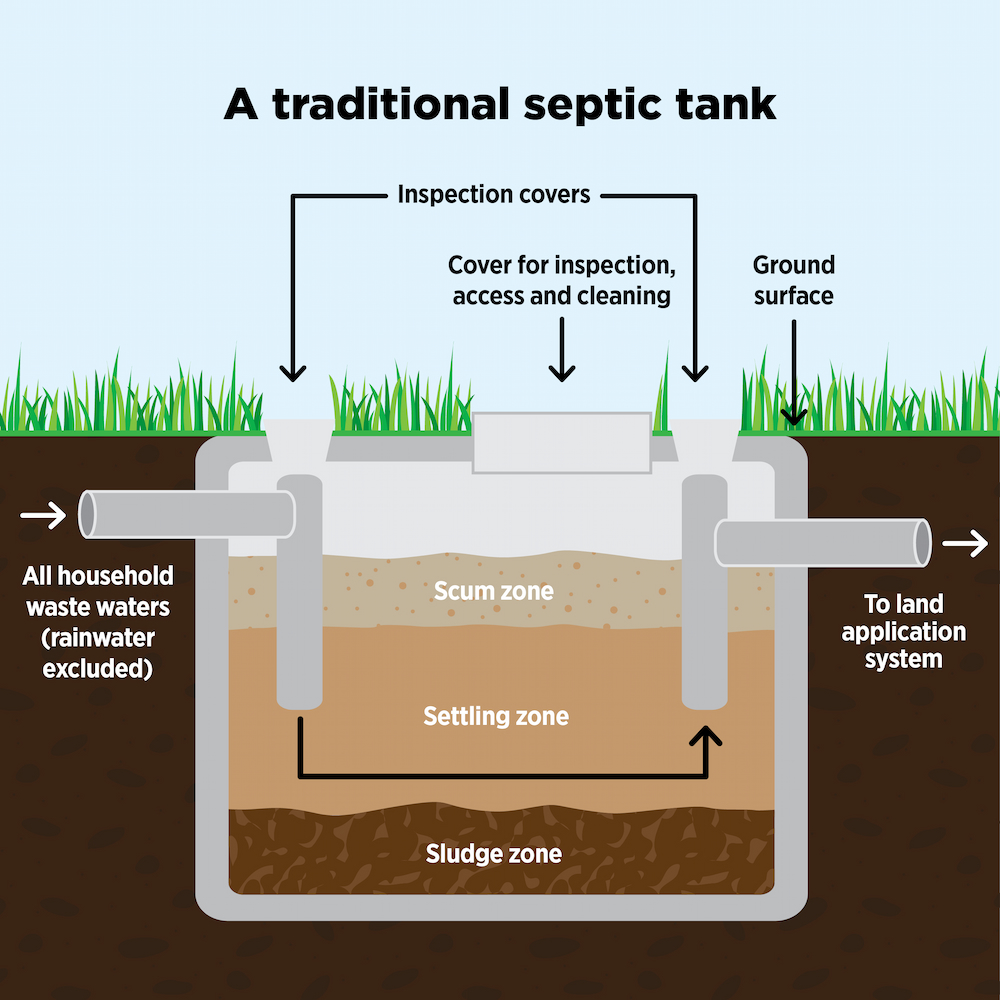
A septic tank is an underground system that:

  • separates solids, fats and liquids
  • uses natural biological processes to help break down waste.

Treated wastewater is then discharged into the soil through a soakage bed and soakage trenches. Installing an outlet filter is recommended. This helps prevent solids entering the soakage area and should be cleaned during pump-outs.

Over time, sludge and scum build up, so regular maintenance is needed to keep the system operating correctly. 

Graphic of a traditional septic tank


Aerated Wastewater Treatment System (AWTS)

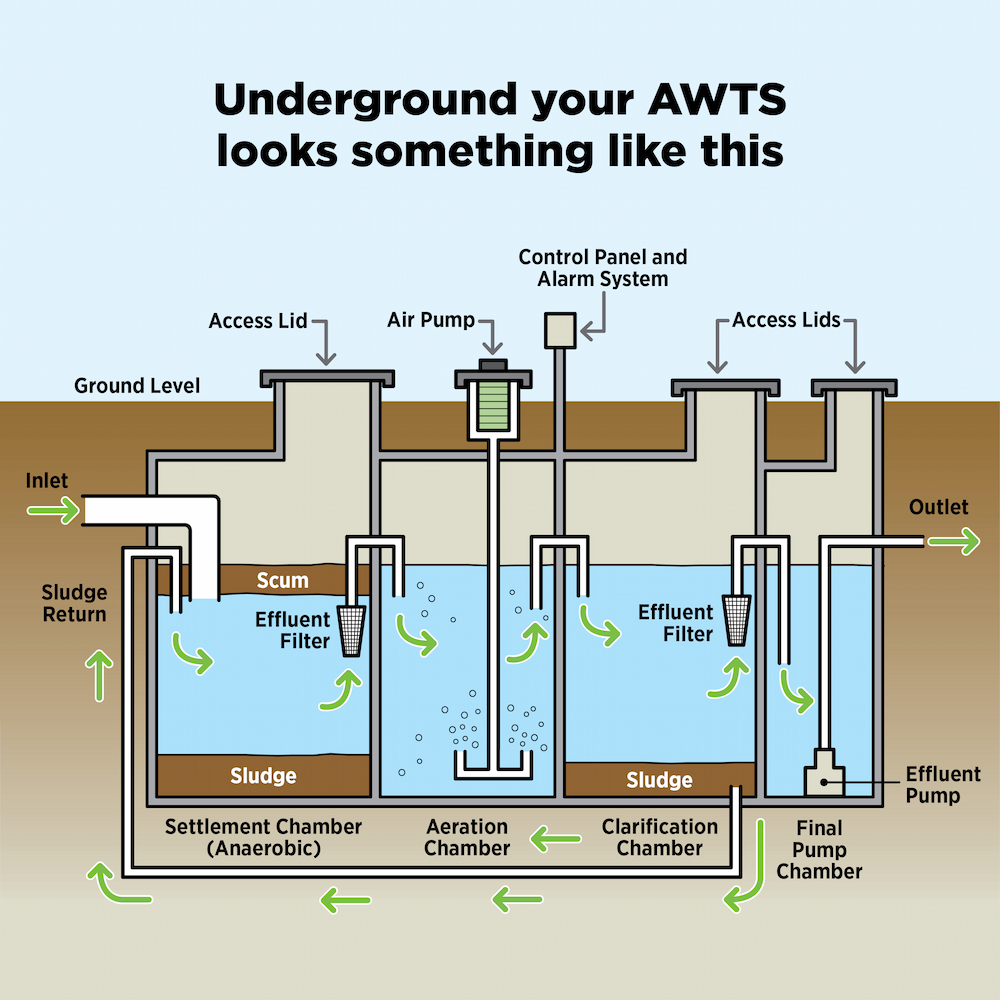
An AWTS provides a higher level of treatment by introducing air to support biological processes that break down wastewater before it is discharged to land.

Graphic of AWTS

An AWTS may be required where a standard septic tank system is not suitable, or where a higher level of treatment is needed to meet the rules. A Bay of Plenty Regional Council-approved OSET designer will be able to assess the site and walk you through the requirements and wastewater treatment options available for consideration.

Only Bay of Plenty Regional Council-approved AWTS units can be installed in this region. These systems must be regularly serviced by a suitably qualified technician, usually every 6 to 12 months, depending on the system and manufacturer’s requirements. These systems require electricity and ongoing maintenance. 

Choosing an advanced wastewater treatment system

If you are considering an AWTS (rather than a septic tank), it’s important to understand the full range of costs, requirements, and responsibilities.

  • If you are located in the Rotorua Lakes catchment
    New systems must be AWTS + NR (nutrient reducing) to help protect lake water quality (see more detail below)
  • Upfront costs
    Does the quote include delivery, installation, irrigation systems, and pumps?
  • Running costs
    Consider ongoing expenses such as electricity, maintenance, and servicing.
  • Servicing and maintenance
    How often is servicing required? What is included? Who will carry out repairs if needed?
  • Operation
    Is the system noisy or odorous? How well does it manage peak use (e.g. holiday periods)? Some chemicals and cleaners can disrupt the biological treatment process.
  • Size and space requirements
    Ensure you have enough space for both the treatment system and disposal field.
  • Warranty and support
    What guarantees are provided, and what support is available
  • References
    Speak to existing users about their experience with the system.
  • Compliance with the Regional Plan
    The system must meet the requirements of the On-Site Effluent Treatment Regional Plan. Check whether the supplier will provide certification confirming compliance (refer to relevant rules in the Plan).

Within the Rotorua Lakes catchment, additional treatment is required to reduce nitrogen entering sensitive waterways.

In these areas, an aerated wastewater treatment system with nutrient-reducing capability must be used, called an Aerated wastewater treatment system with Nitrogen reduction (or AWTS + NR). These systems provide enhanced treatment before wastewater is discharged to land and must be serviced and maintained in the same way as standard AWTS units.

In some cases, an aerated wastewater treatment system (AWTS) may be required.

Aerobic wastewater treatment systems (AWTS) for all Bay of Plenty (including Rotorua)

These secondary treatment systems can be installed anywhere in the Bay of Plenty region without resource consent, subject to requirements outlined in rule 13 of the On-Site Effluent Treatment Plan

Manufacturer

Model

Type of Treatment

Comment

Hynds

Advanced Lifestyle (now Lifestyle Ultimate)

SAF

Max 1800 l/d

Innoflow

Advantex AX 20 Mode 3

RTF

Max 2000 l/d

Ozzi Kleen

RPA 10A+


Tested at 1500 litres per day

TechTreat

CP2 TXT

SAF/RTF

Max 2000 l/d

Waterflow NZ Ltd

Econo-Treat VBB C-2200-2

Submerged Fixed Film

Max 2200 l/d


Aerobic wastewater treatment systems for anywhere in the region except Rotorua catchments

These secondary treatment systems can be installed anywhere in the Bay of Plenty Region with the exception of properties within the Rotorua lakes’ catchments without resource consent, subject to requirements are outlined in rule 12 of the On-Site Effluent Treatment Plan

Manufacturer

Model

Type of Treatment

Comment

Austin Bluewater

AB2K (ABS2000)

SAF

Max 1600 l/d

Biolytix

BioPod

Vermiculture +TF

Max 1600 l/d

Biolytix

MultiPod

Vermiculture +TF

Max 2000 l/d

Devan Plastics

Integra S-15

SAF

Max 1500 l/d

Duracrete

CleanStream TXR-1

Recirculating Textile Filter

Max 1200 l/d

Ecocycle

Fusion

RTF

Max 2000 l/d

Ecological Technologies Ltd

Biorock -S series (Ecorock -2000)

Packed Bed

Max 1500 l/d

Environment Technology

AES-38

Passive Bed

Tested at 1000 litres per day

Everhard

AquaNova (10EP)

SAF

Max 2000 l/d

Findlater

PA 5 x 5 (A2000)

SAF

Max 2000 l/d

FujiClean

ACE NZ1500

Packed Bed

Max 1500 l/d

Hydrozone Environmental

PureFlow

RTF

Max 1400 l/d

Hynds

Lifestyle 2 (Lifestyle Advance)

SAF

Tested at 1000 l/d

Hynds Eloy

Oxyfix

Packed Bed

Max 1800 l/d

Humes | Oasis Clearwater Oasis Clearwater Series 2000I SAF Max 1600 l/d                   

Innoflow

Enviro‑Aire

RTF

Max 2000 l/d

Ozzi Kleen

RP10S


Tested at 1500 litres per day

Reflection

Textile 5000

RTF

Max 2000 l/d

RX Plastics

Airtech 9000

SAF

Max 2000 l/d

Taylex

Poly ABSNR 1350


Tested at 1350 litres per day

Taylex

Poly ABSNR 2000


Tested at 2000 litres per day

Wormsmart NZ

Wormsmart Plus

Vermiculture +TF

Max 1800 l/d

Operating Costs

It is recommended that the running costs and maintenance costs are carefully considered when selecting treatment system, as these can vary widely.